Loading...
Food GuideEat Nepal:
Eat Nepal:
The Definitive Food Guide
From the dal bhat that powers every trek to the king of yoghurts in Bhaktapur — a complete, honest guide to eating in Nepal, with what to order, where to find it, and what to pay.
By Sea & Sky Tours·June 2025·11 min read
Nepali food does not get the attention it deserves. Wedged between the culinary giants of India and China, Nepal has developed its own deeply distinctive cuisine — shaped by altitude, seasons, ethnic diversity, and centuries of trade between the Himalayas and the subcontinent. There are 125 ethnic groups in Nepal, each with its own food traditions. This guide focuses on the dishes every traveller should taste: from the teahouse trail staples that will keep you moving through the mountains, to the ancient Newari feasts that have barely changed in five centuries.
The Essential Dishes
Filter by category, then tap any dish to expand — description, where to find it, what to pay, and a practical trekking tip.
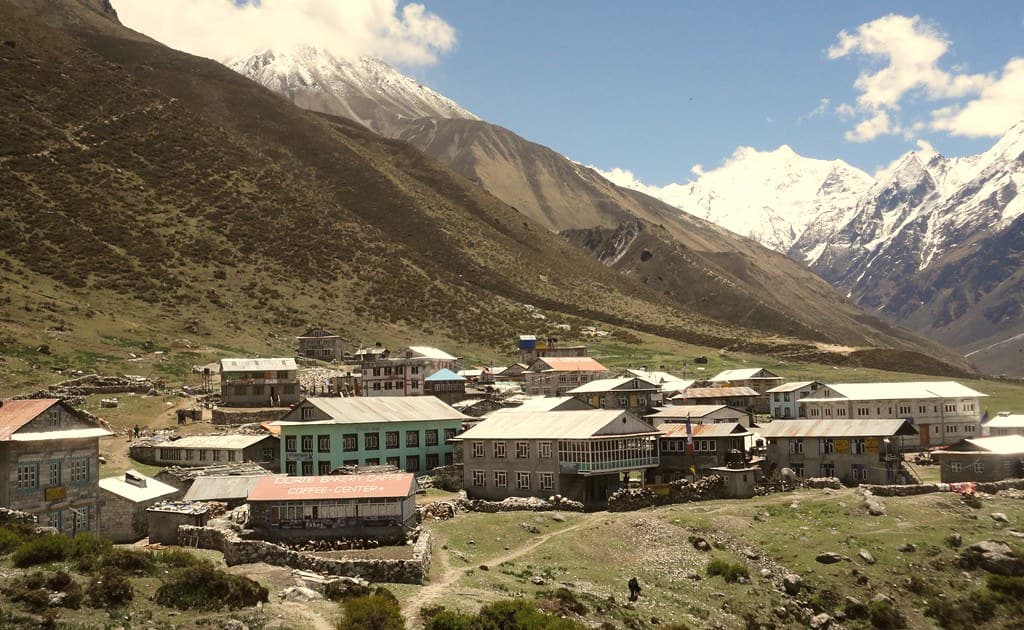
A typical teahouse trail in the Langtang Valley
Understanding Dal Bhat
Dal bhat is not a dish — it is a system. The plate in front of you is less a fixed recipe than a framework: rice at the centre, surrounded by rotating accompaniments that change with the season, the altitude, and the cook's judgement. Here is what the components actually are:
Bhat (भात)
Steamed white rice — long-grain, always freshly cooked. The foundation of every meal, eaten twice daily by the majority of Nepal's 30 million people.
Dal (दाल)
Lentil soup — yellow moong, red masoor, or black kalo dal. Spiced with cumin, turmeric, and mustard oil. Poured over the rice or sipped alongside.
Tarkari (तरकारी)
Seasonal vegetable curry — whatever is fresh. Potato, cauliflower, green beans, pumpkin. Dry-ish in texture, spiced with garam masala.
Achaar (अचार)
Pickle — the most variable element. Tomato achaar, gundruk pickle, radish pickle. Intensely flavoured, a small amount transforms the whole plate.
Saag (साग)
Wilted greens — spinach, mustard greens, or fenugreek. Cooked with garlic and turmeric. The daily iron source for most Nepalis.
Papad
A thin, crispy lentil wafer. Adds texture contrast to an otherwise soft plate. Optional but common in more generous teahouses.
"Dal Bhat Power — 24 Hour"
This Nepali trekking mantra exists for a reason. The combination of slow-release complex carbohydrates from rice, sustained protein from lentils, and micronutrients from seasonal vegetables provides the kind of lasting energy that trail mix and energy bars cannot match. Experienced trekkers often stop ordering the pasta and pizza and simply switch to dal bhat twice a day. They are never hungry and their energy is stable from morning to evening.
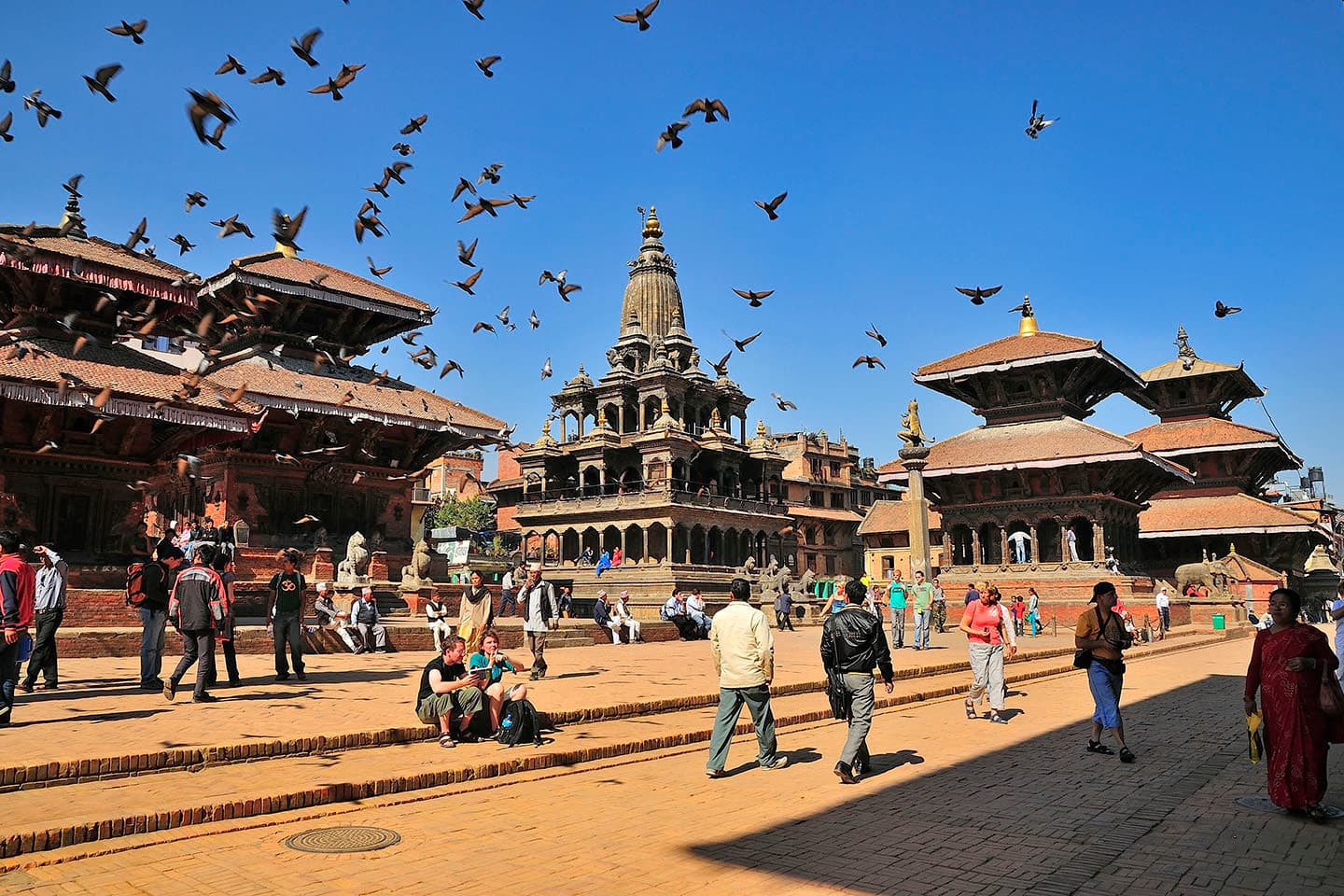
Patan Durbar Square — the best base for a Newari food pilgrimage
A Newari Food Pilgrimage
Newari cuisine is arguably the most sophisticated food tradition in the Himalayas — a 2,000-year-old living food culture shaped by the Kathmandu Valley's position at the centre of the ancient India-Tibet trade route. The Newars absorbed spices and techniques from both directions and refined them into something wholly their own. Here is how to experience it properly:
🏺
Bhaktapur
The best Newari food experience in Nepal. Come for chatamari at the restaurants around Taumadhi Square, buy a clay pot of juju dhau at Pottery Square, and watch sel roti being made at the street stalls. Allow a full day.
🏛️
Patan (Lalitpur)
Better food than Thamel at lower prices. The restaurants around Patan Durbar Square serve excellent buff choila, bara, and thwon (rice beer). The Newari restaurant off Mangal Bazaar is exceptional for a full bhoj set.
🛕
Asan Tole, Kathmandu
The old market quarter — a sensory immersion. Street stalls sell samosas, sekuwa, sel roti, and fresh pani puri from early morning. Eat with the locals, not the tourists.
🎊
A Newari Bhoj (Set Feast)
If you can arrange it through your hotel or guide, a traditional Newari bhoj is one of Nepal's great food experiences — 15+ small dishes including choila, bara, chatamari, tarkari, beaten rice, and home-brewed thwon, served in a private home or community hall.
What to Order at a Teahouse
Teahouse menus on Nepal's major trekking routes look impressively varied — pasta, pizza, apple pie, lasagne — but the further you go from Kathmandu, the more complex those items become to prepare. Here is what to order and what to trust at altitude.
Breakfast
- Tibetan bread with honey & butter
- Eggs (boiled, scrambled, fried, omelette)
- Porridge / muesli with hot milk
- Pancakes with jam
- Chapati with veg curry
- Toast with peanut butter
- Masala chiya or black coffee
Lunch / Dinner
- Dal bhat (always with free refills)
- Thukpa (noodle soup)
- Fried rice
- Chow mein
- Momos (steam or fried)
- Sherpa stew (potato, veg, noodle)
- Soup (tomato, vegetable)
- Pizza (at lower elevations)
- Spring rolls
- Garlic soup (altitude favourite)
⚠ The High-Altitude Menu Rule
Above 3,500m, ingredients like cheese, fresh meat, and vegetables have been carried for many days or flown in at high cost. The teahouse pizza is not lying to you — it is just expensive to make well at altitude. Stick to dal bhat, thukpa, fried rice, and garlic soup above 3,500m. They are freshly made, reliable, digestible, and will serve your body far better than a disappointing pasta.
Staying Healthy: Food Safety
Stomach issues are the most common reason trekkers have a bad experience in Nepal. Most are avoidable.
✓
Eat at busy restaurants
High turnover means fresh ingredients and freshly cooked food. An empty restaurant at peak mealtime is a warning sign.
✓
Drink bottled or boiled water only
Nepal's tap water is not safe to drink untreated. Boiled water (served in teahouses) is fine. Use iodine or a SteriPen for trail water.
✓
Eat freshly cooked food
The dal bhat you see being cooked in the kitchen moments before it arrives is always safe. Reheated or pre-made food carries more risk.
✓
Peel fruit yourself
Fresh fruit is generally safe if you peel it yourself. Avoid pre-cut fruit sold at stalls.
✗
Raw salads in rural areas
Salad vegetables are often washed in tap water. Safe in quality restaurants in Kathmandu; use caution in teahouses and rural areas.
✗
Street ice cream and dairy in heat
Cold chain is unreliable outside major cities. Exception: juju dhau in Bhaktapur is made and sold fresh the same day.
✓
Reduce meat above 3,500m
At altitude, digestion slows. Stick to vegetarian dal bhat, thukpa, and soups above 3,500m for faster digestion and better energy.
Taste it yourself
Our guides know every great teahouse on the trail
Ask your Sea & Sky guide where the best dal bhat on the route is — they will have a definitive opinion. They always do.
Plan Your Trip